
Reclaiming Epione: Nursing, Compassion, and a Profession Rediscovered
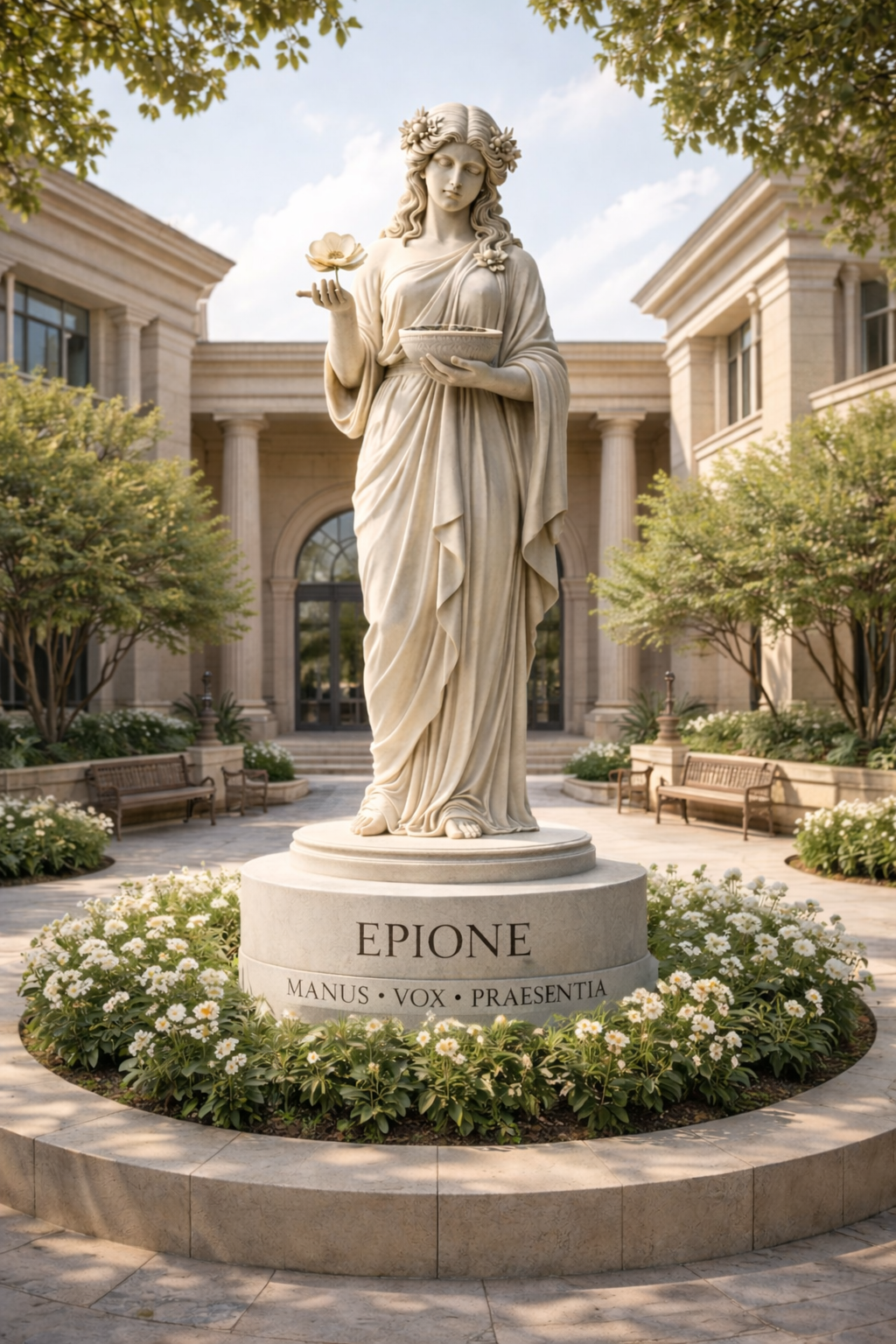
Epione statue in university courtyard.
A Forgotten Goddess and a Forgotten Truth
Healthcare has long relied on powerful symbols to represent its ethical traditions. Physicians often trace their professional identity to the Hippocratic Oath and the teachings of Hippocrates.
Yet another figure in the mythology of healing has largely been forgotten: Epione, the Greek goddess who soothed pain and comforted the afflicted.
Epione was the wife of Asclepius, the god of medicine. While Asclepius symbolized the science of curing disease, Epione represented something equally essential: the gentle relief of suffering.
Her name derives from the Greek word meaning soothing or relief from pain. Together with Asclepius, she was the mother of several figures associated with healing, including Hygieia, the goddess of health and prevention, and Panacea, the goddess of universal remedy.
Despite her central role in the mythology of healing, Epione gradually faded from the symbolic traditions of healthcare.
In many ways, the story of Epione mirrors the story of nursing itself.
Nursing: A Profession Older Than Medicine
Long before formal medical schools existed, societies relied on individuals who cared for the sick, comforted the dying, and tended to the vulnerable.
These early caregivers performed the essential tasks of healing:
tending wounds
preparing herbal remedies
comforting the suffering
supporting families through illness and death
In other words, nursing existed long before medicine became an organized profession.
Even in ancient Greek healing temples dedicated to Asclepius, attendants cared for patients overnight, offering comfort and support while physicians performed diagnostic rituals and treatments.
These attendants were performing what we would now recognize as nursing care.
Yet historically, caregiving work (particularly work performed by women) was often undervalued or viewed as service rather than a profession.
Like Epione, nursing quietly stood in the background of the healing arts.
The Backbone of Healthcare
Today, the importance of nursing is impossible to ignore.
Globally, nurses represent the largest segment of the healthcare workforce.
Research estimates there are nearly 29 million nurses worldwide, representing almost 60% of the global healthcare workforce.
In many healthcare systems:
there are two to three nurses for every physician
nurses provide the majority of direct patient care interactions
Yet despite this enormous responsibility, nursing has often struggled for recognition as a profession equal in importance to other healthcare disciplines.
The reasons are complex:
historical gender dynamics
hierarchical healthcare structures
misconceptions about nursing scope of practice
Yet healthcare systems simply cannot function without nurses.
The Ethical Foundations of Nursing
Modern healthcare ethics often emphasize four core principles:
Autonomy: Respecting patient decisions
Beneficence: Promoting well-being
Non-Maleficence: Avoiding harm
Justice: Fairness in care
Nursing ethics frequently adds a fifth principle:
Fidelity: Honoring the trust between patient and caregiver.
Beyond these principles, nursing emphasizes values that are sometimes harder to quantify but no less important:
Presence with those who suffer
Advocacy for vulnerable patients
Holistic care addressing emotional and social needs
These values reflect the spirit of Epione herself, the compassionate relief of suffering.
Why Epione Matters for Nurse Practitioners
Nursing continues to evolve. Nurse Practitioners and Advanced Practice Registered Nurses diagnose illness, prescribe medications, manage chronic disease, and provide comprehensive care.
Yet despite this expanding scope, many nurses still encounter misconceptions about their professional identity.
Reclaiming the story of Epione reminds us that nursing has always been central to healing.
Nursing and Nurse Practitioners embody the same values Epione represents:
relieving suffering
advocating for patients
providing compassionate care
While medicine looks to Hippocrates and the Rod of Asclepius for symbolic identity, nursing has often lacked a unifying symbol reflecting its ethical foundation.
Rediscovering Epione offers a way to reclaim that narrative.
By embracing this symbolism, nursing reaffirms its role not as a secondary discipline, but as a coequal partner in the healing professions.
Reclaiming our past, allows us to transcend the present, and secure our future.
The Three Gifts of Epione
The philosophy of Epione can be summarized in three simple ideals:
Hands: Healing
Voice: Advocacy
Presence: Compassion
Together they represent the essence of nursing.
Final Thoughts
Medicine may focus on curing disease.
Nursing has always focused on something equally important: relieving suffering.
Rediscovering Epione reminds us that compassion, advocacy, and presence are not secondary to healing, they are fundamental to it.
Perhaps it is time nursing had its own symbol from its ancient origins.
Call to Action
If you or someone you love is struggling with stress, burnout, anxiety, or depression, compassionate support can make a meaningful difference.
At Desert Willow Behavioral Health, we provide integrative, patient-centered mental health care.
📞 Schedule your FREE 15-minute consultation today.
